The Movement of Nitrogen From the Nonliving Environment Into Living Things and Back Again
2.eight: Biogeochemical Cycles
- Page ID
- 32469
Free energy flows directionally through ecosystems, entering as sunlight (or inorganic molecules for chemoautotrophs) and leaving as heat during free energy transformation between trophic levels. Rather than flowing through an ecosystem, the affair that makes upward organisms is conserved and recycled. The vi most mutual elements associated with organic molecules—carbon, nitrogen, hydrogen, oxygen, phosphorus, and sulfur—take a variety of chemical forms and may exist for long periods in the atmosphere, on land, in water, or beneath Globe'south surface. Geologic processes, such as weathering, erosion, h2o drainage, and the subduction of the continental plates, all play a role in the cycling of elements on Earth. Because geology and chemistry have major roles in the report of these processes, the recycling of inorganic matter between living organisms and their nonliving surroundings are called biogeochemical cycles.
The 6 same elements are used by organisms in a variety of ways. Hydrogen and oxygen are found in water and organic molecules, both of which are essential to life. Carbon is found in all organic molecules, whereas nitrogen is an important component of nucleic acids and proteins. Phosphorus is used to make nucleic acids and the phospholipids that comprise biological membranes. Lastly, sulfur is critical to the three-dimensional shape of proteins.
The cycling of these elements is interconnected. For example, the movement of water is critical for the leaching of sulfur and phosphorus into rivers, lakes, and oceans. Minerals cycle through the biosphere between the biotic and abiotic components and from one organism to another.
The Water Cycle
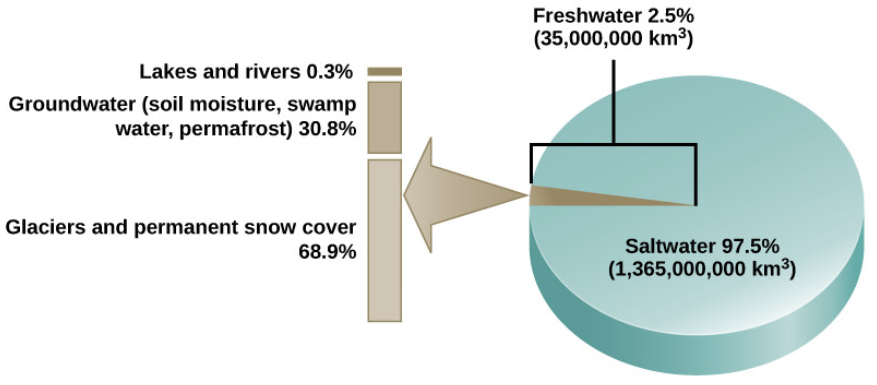
The hydrosphere is the area of Earth where water motility and storage occurs: as liquid water on the surface (rivers, lakes, oceans) and beneath the surface (groundwater) or ice, (polar ice caps and glaciers), and as water vapor in the atmosphere.The human torso is about 60 percent h2o and man cells are more than lxx percent h2o. Of the stores of water on Earth, 97.five percent is salt water (see Effigy \(\PageIndex{1}\) beneath). Of the remaining water, more than 99 percent is groundwater or water ice. Thus, less than one percent of freshwater is nowadays in lakes and rivers. Many organisms are dependent on this modest pct, a lack of which tin take negative effects on ecosystems. Humans, of course, have developed technologies to increase water availability, such every bit earthworks wells to harvest groundwater, storing rainwater, and using desalination to obtain drinkable water from the ocean. Although this pursuit of drinkable water has been ongoing throughout human history, the supply of fresh water continues to be a major issue in modern times.
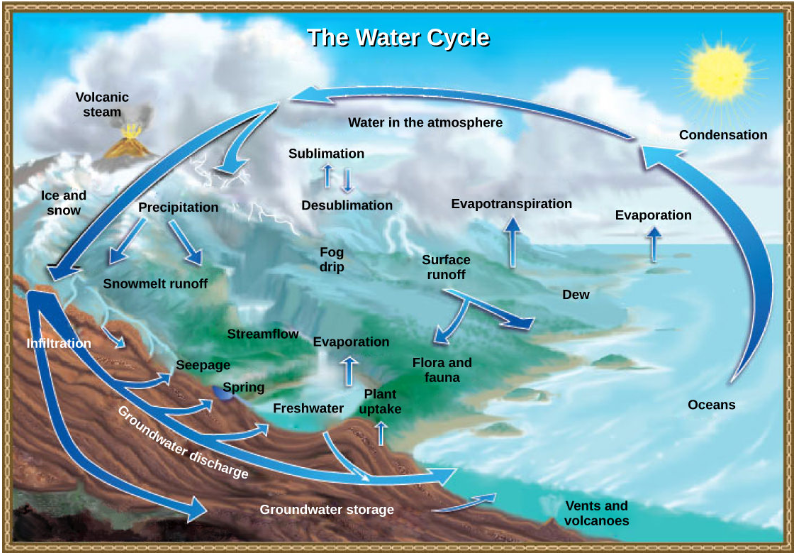
The various processes that occur during the cycling of water are illustrated in Figure \(\PageIndex{2}\) below. The processes include the following:
- evaporation and sublimation
- condensation and precipitation
- subsurface water flow
- surface runoff and snowmelt
- streamflow
The water cycle is driven past the Dominicus's energy equally it warms the oceans and other surface waters. This leads to evaporation (liquid water to h2o vapor) of liquid surface water and sublimation (ice to water vapor) of frozen h2o, thus moving big amounts of water into the atmosphere every bit water vapor. Over time, this water vapor condenses into clouds as liquid or frozen droplets and eventually leads to precipitation (rain, snow, hail), which returns water to Earth's surface. Pelting reaching World'south surface may evaporate again, menstruum over the surface, or percolate into the ground. Almost easily observed is surface runoff: the catamenia of freshwater over state either from rain or melting ice. Runoff tin brand its manner through streams and lakes to the oceans.
In most natural terrestrial environments rain encounters vegetation earlier it reaches the soil surface. A meaning per centum of h2o evaporates immediately from the surfaces of plants. What is left reaches the soil and begins to motion down. Surface runoff volition occur simply if the soil becomes saturated with water in a heavy rainfall. H2o in the soil can be taken up by plant roots. The establish volition use some of this water for its ain metabolism and some of that will find its fashion into animals that eat the plants, but much of it will be lost back to the atmosphere through a process known as transpiration: water enters the vascular system of plants through the roots and evaporates, or transpires, through the stomata (small microscope openings) of the leaves. Ecologists combine transpiration and evaporation into a unmarried term that describes h2o returned to the atmosphere: evapotranspiration. Water in the soil that is non taken up past a found and that does not evaporate is able to percolate into the subsoil and bedrock where it forms groundwater.
Groundwater is a pregnant, subsurface reservoir of fresh water. Information technology exists in the pores between particles in dirt, sand, and gravel or in the fissures in rocks. Groundwater can period slowly through these pores and fissures and eventually finds its way to a stream or lake where information technology becomes office of the surface water again. Many streams flow not considering they are replenished from rainwater directly merely considering they receive a constant inflow from the groundwater below. Some groundwater is found very deep in the boulder and can persist there for millennia. Nigh groundwater reservoirs, or aquifers, are the source of drinking or irrigation h2o drawn upwards through wells. In many cases these aquifers are being depleted faster than they are beingness replenished by water percolating downward from to a higher place.
Rain and surface runoff are major means in which minerals, including phosphorus and sulfur, are cycled from land to water. The environmental furnishings of runoff volition be discussed later every bit these cycles are described.
The Carbon Cycle
Carbon is the second most arable element in organisms, by mass. Carbon is present in all organic molecules (and some molecules that are not organic such as CO2), and its role in the structure of biomolecules is of principal importance. Carbon compounds contain free energy, and many of these compounds from dead plants and algae have fossilized over millions of years and are known as fossil fuels. Since the 1800s, the utilize of fossil fuels has accelerated. Since the get-go of the Industrial Revolution the demand for Earth's limited fossil fuel supplies has risen, causing the amount of carbon dioxide in our atmosphere to drastically increment. This increase in carbon dioxide is associated with climate change and is a major environmental business worldwide.
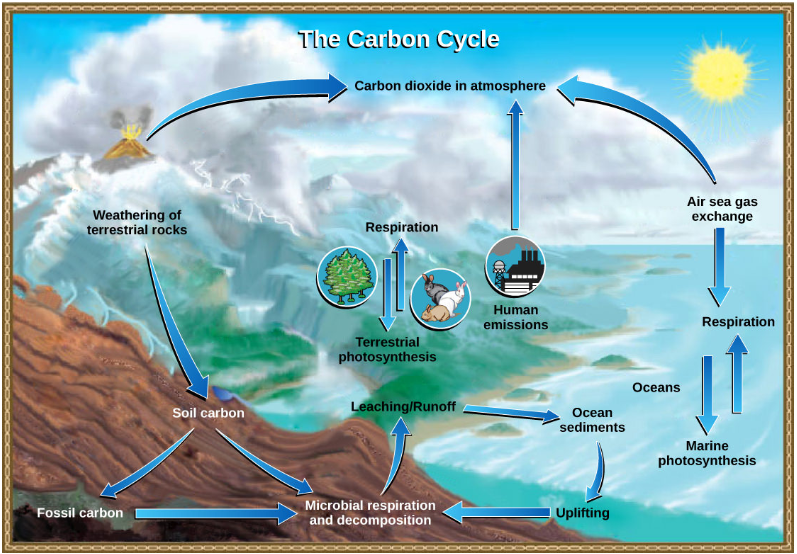
The carbon cycle is nigh easily studied equally 2 interconnected subcycles: one dealing with rapid carbon commutation among living organisms and the other dealing with the long-term cycling of carbon through geologic processes. The unabridged carbon cycle is shown in Figure \(\PageIndex{3}\) below.
The Biological Carbon Cycle
Organisms are connected in many ways, even amongst unlike ecosystems. A good instance of this connectedness is the exchange of carbon betwixt heterotrophs and autotrophs by way of atmospheric carbon dioxide. Carbon dioxide (COtwo) is the basic building block that autotrophs utilise to build high-energy compounds such as glucose. The energy harnessed from the Sun is used by these organisms to form the covalent bonds that link carbon atoms together. These chemic bonds store this energy for later on employ in the process of respiration. Well-nigh terrestrial autotrophs obtain their carbon dioxide straight from the atmosphere, while marine autotrophs acquire information technology in the dissolved course (bicarbonate, HCOthree –).
Carbon is passed from producers to higher trophic levels through consumption. For example, when a cow (primary consumer) eats grass (producer), it obtains some of the organic molecules originally fabricated by the plant's photosynthesis. Those organic compounds tin then exist passed to higher trophic levels, such as humans, when we eat the cow. At each level, nonetheless, organisms are performing respiration, a process in which organic molecules are broken down to release energy. Equally these organic molecules are broken down, carbon is removed from nutrient molecules to course COii, a gas that enters the atmosphere. Thus, COii is a byproduct of respiration. Recall that CO2 is consumed by producers during photosynthesis to make organic molecules. As these molecules are broken downwards during respiration, the carbon once once more enters the atmosphere every bit CO2. Carbon exchange similar this potentially connects all organisms on Earth. Call up about this: the carbon in your DNA was in one case office of plant; millions of years ago perhaps information technology was role of dinosaur.
The Biogeochemical Carbon Bicycle
The move of carbon through land, water, and air is complex, and, in many cases, it occurs much more slowly than the movement between organisms. Carbon is stored for long periods in what are known every bit carbon reservoirs, which include the atmosphere, bodies of liquid water (more often than not oceans), ocean sediment, soil, rocks (including fossil fuels), and Earth's interior.
Equally stated, the atmosphere is a major reservoir of carbon in the form of carbon dioxide that is essential to the process of photosynthesis. The level of carbon dioxide in the temper is greatly influenced past the reservoir of carbon in the oceans. The substitution of carbon betwixt the atmosphere and water reservoirs influences how much carbon is plant in each. Carbon dioxide (CO2) from the atmosphere dissolves in h2o and reacts with water molecules to form ionic compounds. Some of these ions combine with calcium ions in the seawater to form calcium carbonate (CaCO3), a major component of the shells of marine organisms. These organisms somewhen die and their shells class sediments on the ocean floor. Over geologic time, the calcium carbonate forms limestone, which comprises the largest carbon reservoir on Earth.
On country, carbon is stored in soil as organic carbon as a result of the decomposition of organisms or from weathering of terrestrial rock and minerals (the world's soils hold significantly more than carbon than the atmosphere, for comparison). Deeper clandestine are fossil fuels, the anaerobically decomposed remains of plants and algae that lived millions of years ago. Fossil fuels are considered a non-renewable resource because their use far exceeds their rate of formation. A non-renewable resource is either regenerated very slowly or not at all. Another way for carbon to enter the atmosphere is from land (including land below the surface of the ocean) by the eruption of volcanoes and other geothermal systems. Carbon sediments from the body of water flooring are taken deep inside Earth past the process of subduction: the movement of one tectonic plate beneath another. Carbon is released as carbon dioxide when a volcano erupts or from volcanic hydrothermal vents.
The Nitrogen Cycle
Getting nitrogen into living organisms is difficult. Plants and phytoplankton are non equipped to contain nitrogen from the atmosphere (where it exists as tightly bonded, triple covalent Northward2) even though this molecule comprises approximately 78 percent of the atmosphere. Nitrogen enters the living world through free-living and symbiotic bacteria, which comprise nitrogen into their organic molecules through specialized biochemical processes. Certain species of bacteria are able to perform nitrogen fixation, the process of converting nitrogen gas into ammonia (NH3), which spontaneously becomes ammonium (NH4 +). Ammonium is converted by leaner into nitrites (NOii −) and so nitrates (NOthree −). At this point, the nitrogen-containing molecules are used by plants and other producers to make organic molecules such as Deoxyribonucleic acid and proteins. This nitrogen is at present available to consumers.
Organic nitrogen is specially important to the study of ecosystem dynamics because many ecosystem processes, such as main product, are limited by the available supply of nitrogen. As shown in Figure \(\PageIndex{four}\) below, the nitrogen that enters living systems is eventually converted from organic nitrogen dorsum into nitrogen gas past bacteria (Effigy \(\PageIndex{four}\)). The process of denitrification is when bacteria catechumen the nitrates into nitrogen gas, thus allowing it to re-enter the atmosphere.
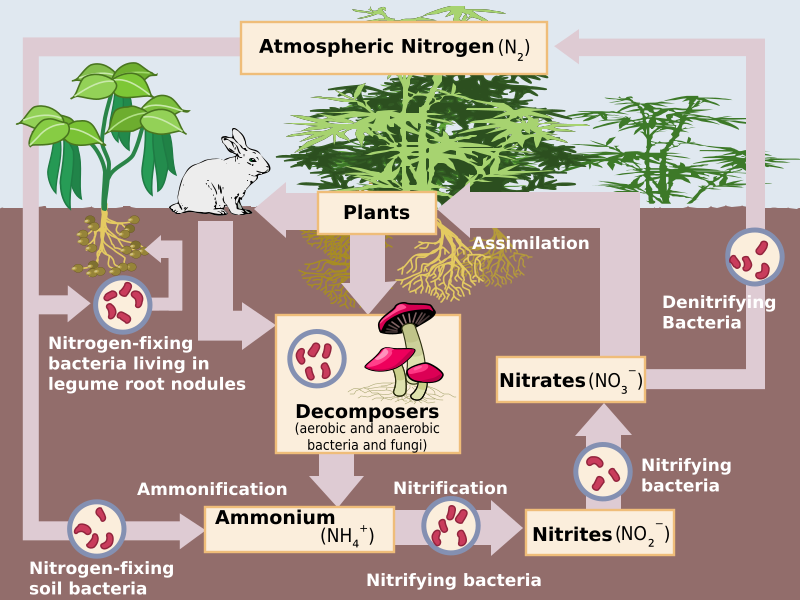
Human action tin alter the nitrogen bicycle by 2 principal means: the combustion of fossil fuels, which releases unlike nitrogen oxides, and by the use of artificial fertilizers (which incorporate nitrogen and phosphorus compounds) in agronomics, which are so washed into lakes, streams, and rivers by surface runoff. Atmospheric nitrogen (other than Due north2) is associated with several effects on Earth's ecosystems including the production of acrid rain (equally nitric acid, HNO3) and greenhouse gas furnishings (as nitrous oxide, N2O), potentially causing climate change. A major issue from fertilizer runoff is saltwater and freshwater eutrophication, a process whereby nutrient runoff causes the overgrowth of algae, the depletion of oxygen, and death of aquatic fauna.
In marine ecosystems, nitrogen compounds created by leaner, or through decomposition, collects in ocean floor sediments. It tin can then be moved to land in geologic time past uplift of Earth'south chaff and thereby incorporated into terrestrial rock. Although the movement of nitrogen from stone directly into living systems has been traditionally seen every bit insignificant compared with nitrogen fixed from the atmosphere, a recent study showed that this process may indeed be significant and should be included in any study of the global nitrogen bike.
The Phosphorus Cycle
Phosphorus is an essential nutrient for living processes. It is a major component of nucleic acids and phospholipids, and, as calcium phosphate, it makes upwardly the supportive components of our bones. Phosphorus is often the limiting nutrient (necessary for growth) in aquatic, particularly freshwater, ecosystems.
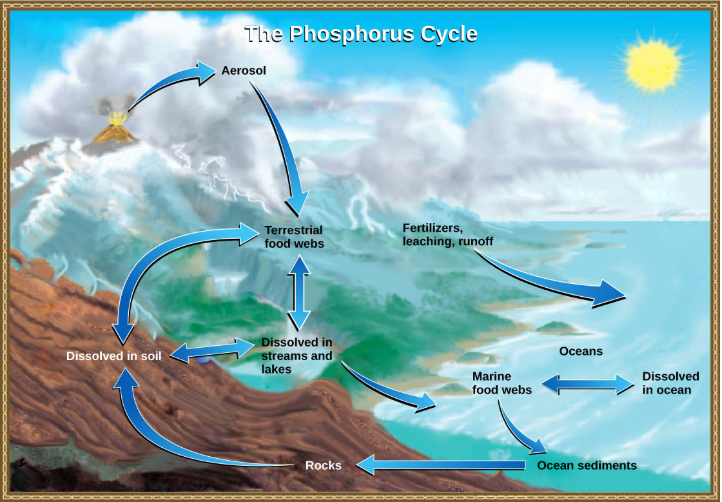
Phosphorus occurs in nature as the phosphate ion (PO4 3-). In improver to phosphate runoff equally a result of act, natural surface runoff occurs when information technology is leached from phosphate-containing stone by weathering, thus sending phosphates into rivers, lakes, and the ocean. This rock has its origins in the sea. Phosphate-containing ocean sediments course primarily from the bodies of ocean organisms and from their excretions. Nevertheless, volcanic ash, aerosols, and mineral grit may also be significant phosphate sources. This sediment then is moved to state over geologic time by the uplifting of Earth's surface. (Figure below)
Phosphorus is also reciprocally exchanged betwixt phosphate dissolved in the ocean and marine organisms. The movement of phosphate from the ocean to the land and through the soil is extremely wearisome, with the average phosphate ion having an oceanic residence time between 20,000 and 100,000 years.
Excess phosphorus and nitrogen that enter these ecosystems from fertilizer runoff and from sewage cause excessive growth of algae. The subsequent death and decay of these organisms depletes dissolved oxygen, which leads to the death of aquatic organisms such equally shellfish and fish. This process is responsible for dead zones in lakes and at the mouths of many major rivers and for massive fish kills, which often occur during the summer months (encounter Figure \(\PageIndex{6}\) below).
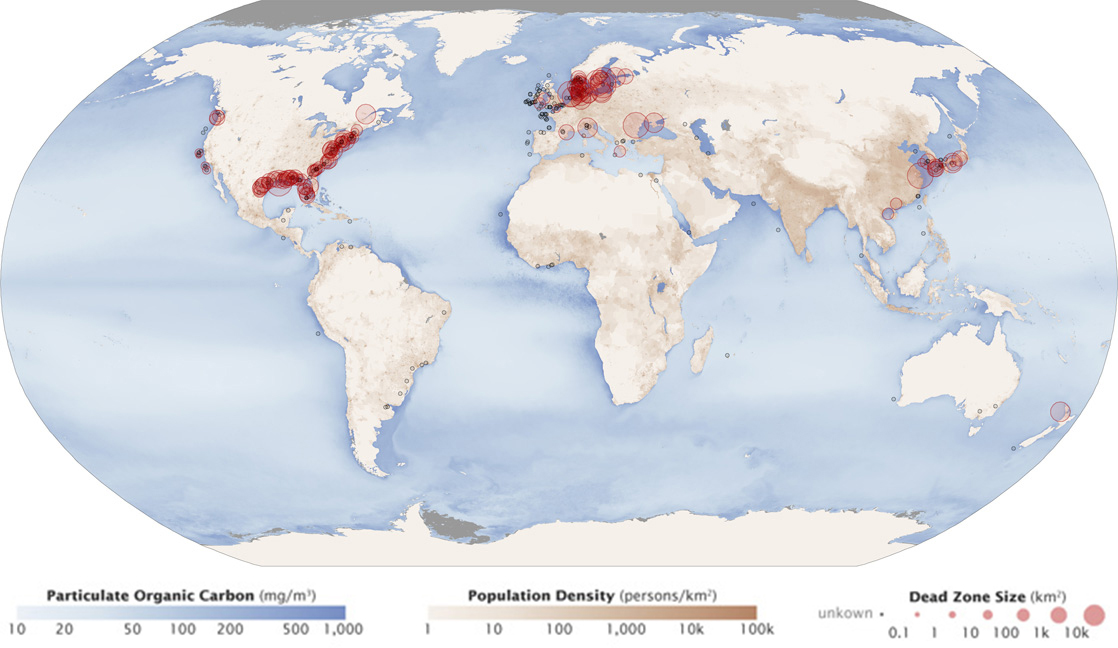
A dead zone is an area in lakes and oceans almost the mouths of rivers where large areas are periodically depleted of their normal flora and fauna. These zones are caused by eutrophication coupled with other factors including oil spills, dumping toxic chemicals, and other human activities. The number of dead zones has increased for several years, and more than 400 of these zones were nowadays as of 2008. One of the worst dead zones is off the coast of the United States in the Gulf of Mexico: fertilizer runoff from the Mississippi River basin created a dead zone of over eight,463 square miles. Phosphate and nitrate runoff from fertilizers also negatively touch several lake and bay ecosystems including the Chesapeake Bay in the eastern Usa.
The Sulfur Bike
Sulfur is an essential element for the molecules of living things. Every bit function of the amino acrid cysteine, it is involved in the formation of proteins. As shown in Figure \(\PageIndex{7}\) below, sulfur cycles between the oceans, land, and atmosphere. Atmospheric sulfur is establish in the class of sulfur dioxide (SOtwo), which enters the atmosphere in three means: kickoff, from the decomposition of organic molecules; 2nd, from volcanic activity and geothermal vents; and, third, from the burning of fossil fuels by humans.
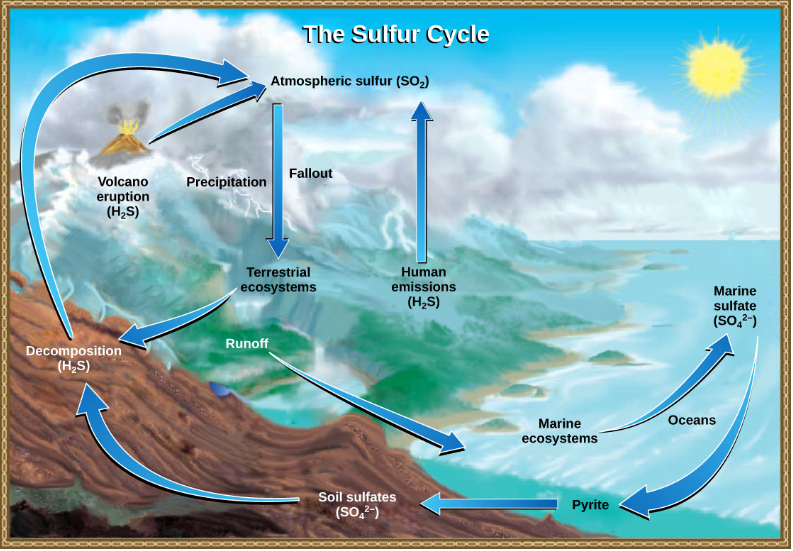
On land, sulfur is deposited in four major ways: precipitation, straight fallout from the atmosphere, rock weathering, and geothermal vents. Atmospheric sulfur is constitute in the form of sulfur dioxide (SOtwo), and equally rain falls through the atmosphere, sulfur is dissolved in the form of weak sulfuric acid (H2Theniv). Sulfur can also fall directly from the atmosphere in a process called fallout. Also, as sulfur-containing rocks weather, sulfur is released into the soil. These rocks originate from ocean sediments that are moved to country by the geologic uplifting of bounding main sediments. Terrestrial ecosystems tin can then make use of these soil sulfates (SOiv 2-), which enter the food spider web past being taken up past plant roots. When these plants decompose and die, sulfur is released back into the atmosphere equally hydrogen sulfide (H2S) gas.
Sulfur enters the ocean in runoff from land, from atmospheric fallout, and from underwater geothermal vents. Some ecosystems rely on chemoautotrophs using sulfur equally a biological energy source. This sulfur then supports marine ecosystems in the form of sulfates.
Homo activities have played a major part in altering the residual of the global sulfur cycle. The burning of large quantities of fossil fuels, particularly from coal, releases larger amounts of hydrogen sulfide gas into the atmosphere. Every bit pelting falls through this gas, it creates the phenomenon known equally acid rain, which damages the natural environment by lowering the pH of lakes, thus killing many of the resident plants and animals. Acid pelting is corrosive pelting caused by rainwater falling to the footing through sulfur dioxide gas, turning it into weak sulfuric acid, which causes damage to aquatic ecosystems. Acid pelting too affects the man-made environment through the chemical degradation of buildings. For example, many marble monuments, such as the Lincoln Memorial in Washington, DC, have suffered pregnant damage from acid rain over the years. These examples evidence the wide-ranging effects of homo activities on our environment and the challenges that remain for our hereafter.
Contributors and Attributions
- Biogeochemical Cycles by OpenStax is licensed under CC By 4.0. Modified from the original by Matthew R. Fisher.
Source: https://bio.libretexts.org/Courses/Monterey_Peninsula_College/MPC_Environmental_Science/02:_Environmental_Systems/2.08:_Biogeochemical_Cycles
0 Response to "The Movement of Nitrogen From the Nonliving Environment Into Living Things and Back Again"
Post a Comment